
What are Binary Stars?
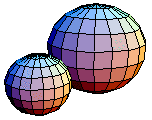
Most stars are found in groups of stars that are gravitationally bound with each other. The majority of these stars are found in binary systems which are systems of two stars in orbit around a common center of mass. One can classify binary stars based on their appearance from earth. Stars that are far enough apart to be distinguished from each other are known as visual binaries. Other binaries are too close and far away to be seen separately but can distinguished using the doppler shift of their spectra. These are spectroscopic binaries.
 In rare instances, such as with the star Algol the binary stars are close enough so that the eclipse one another. In this case, one can calculate not only the mass of the binary star systems, but also the radii of the stars.
Software and Theory
The Basics
- A Simple Light Curve Model [HTM]
- Limb Darkening Defined [HTM]
- Heliocentric Julian Day [HTM]
- Binary Star Lecture [PPT]
- Student Exercises [DOC]
Excel Worksheets
- Simple Light Curve Worksheet [XLS]
- Rotating Star Shapes [XLS]
- Roche Lobes [XLS]
- Lagrange Points [XLS]
- 3D Potential [XLS]
- Julian Day [XLS]
Software Collection
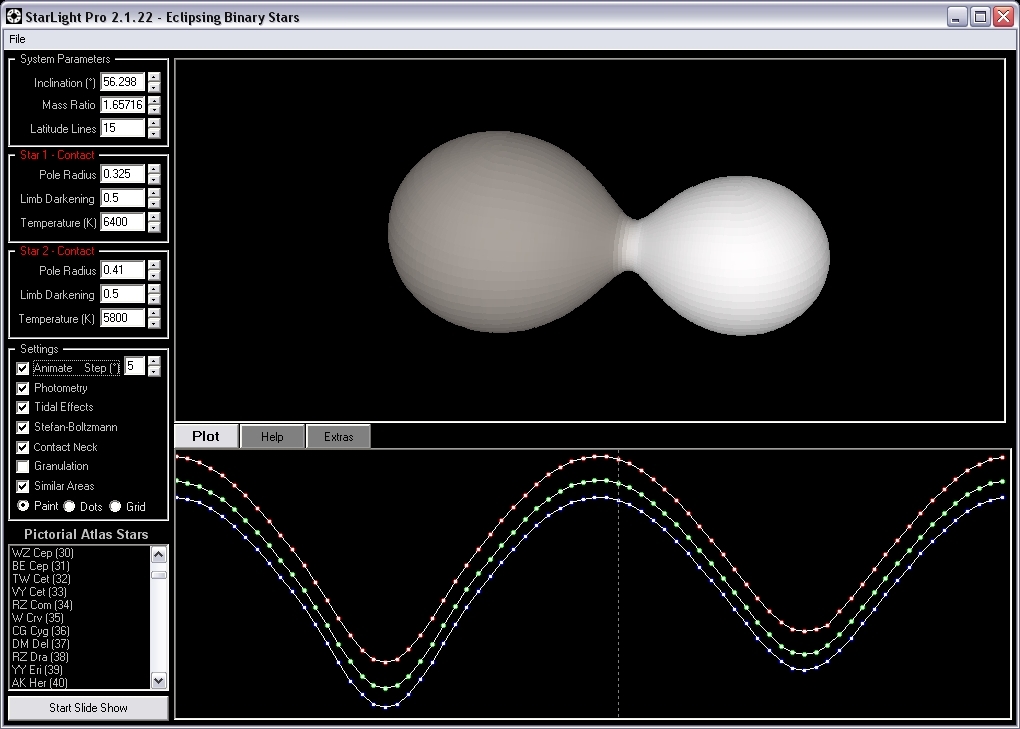
- StarLight Pro
- StarLight Pro produces animated views of eclipsing binary stars and calculate synthetic lightcurves. The effects of limb darkening, temperature, inclination, stellar size, mass ratio, and star shape are included. This is a free download for Windows.
- Binary View
- Windows software provided by Alexander Hobbs at Leicester University, UK.
- JAVA Simulations of Binary Stars
- JAVA Example from Cornell University.
- Eclipsing Binary Simulator
- EBS is a Windows astronomy application to visualise the orbit and synthetic light curve of binary star systems. It is made for educational purposes and for having fun.
- Binary Stars
- Free astronomical software for Macintosh computers, complete with manuals, teaching binary star concepts, for classroom or personal use.
- Wilson-Devinney Code
- Fortran code provided by Robert E. Wilson a the University of Florida.
- Binary Maker
- Commercial software by Contact Software.
- BASIC Programs from Sky & Telescope
- BASIC code for modeling binary stars: BINARY.BAS, GOSS.BAS, PULSAR.BAS, PERIOD.BAS
- Phases
- Fanel Donea's DOS program that computes heliocentric phases.
Lists of Eclipsing Binary Stars
- BAV Data
- The BAV Data contains the complete observational results (maxima and minima) of the BAV on eclipsing binaries, short- and longperiod pulsating stars, cataclysmic and eruptive variables.
- General Catalogue of Variable Stars: [ SFA Excel | Site 1 | Site 2 | Site 3 ] - Type Key
- An Atlas of O-C Diagrams of Eclipsing Binary Stars
- Stars from Binary Stars: A Pictorial Atlas
Online Articles and More Information
- Open European Journal on Variable Stars
- Photometry of 68 Herculis
- Watching Beta Lyrae Evolve
- First Resolved Images of the Eclipsing and Interacting Binary ß Lyrae
- Southwest Research Institute Articles
- Eric's World of Astronomy
- Astronomy Picture of the Day
- IBVS - Information Bulletin on Variable Stars
- AAVSO - American Association of Variable Star Observers
- SIMBAD Astronomical Database or US Mirror
- Eclipsing Binaries Minima Database
Visual Binary Stars »