Properties of Stars
An Atlas of Stellar Spectra - The Atlas of Stellar Spectra and the accompanying outline have been prepared from the viewpoint of the practical stellar astronomer.
Annie Jump Cannon - During her career Annie Jump Cannon discovered over 300 variable stars. Her specialty was classifying the characteristics of stars - over 350,000 of them. The results of her work appeared in The Henry Draper Catalogue (1918-24) and The Henry Draper Extension (1925-36).
Hydrostatic Equilibrium - The Sun and most stars do not change over long timescales. This implies that they exist in a state of near equilibrium with gravity balanced by pressure.
Luminosity and Spectral Class - The classification of stars according to their spectra; each major spectral classification is given a letter, with additional numbers providing further subdivisions.
Magnitudes and Distance - This primer describes the magnitude system and derives all of the equations relating magnitudes to distances.
Mass-Luminosity Relationship - Detailed observations, particularly in binary star systems where masses can be determined with some reliability, indicate that there is a correlation between the mass of a star and its luminosity.
Spectroscopic Parallax - Given a star's apparent magnitude and its luminosity (absolute magnitude), the distance can be determined.
Standard Candle - Standard candles are one of the critical ways we have found to help us measure cosmic distances. The principle, if not the application, is quite simple: if you could find an object whose luminosity (brightness) you knew absolutely just from looking at it, then by comparing the apparent luminosity with the absolute luminosity, you could figure how far away it was.
Stefan-Boltzmann Law - The Stefan-Boltzmann Law states that total spectral radiant exitance (W) leaving a blackbody is proportional to the fourth power of its temperature (T).
Stellar Magnitudes - A basic observable quantity for a star is its brightness. Because stars can have a very broad range of brightness, astronomers commonly introduce a logarithmic scale called a magnitude scale to classify the brightness.
Stellar Magntitude System - Star magnitudes do count backward, the result of an ancient fluke that seemed like a good idea at the time. The story begins around 129 B.C., when the Greek astronomer Hipparchus produced the first well-known star catalog.
Stellar Masses - An important application of binary systems is that under favorable circumstances they provide one of the only ways to determine reliable masses for stars.
Stellar Parallax - Applet - Stellar distance estimates are crucial to understanding stellar properties and underpin the whole distance network for galactic and extragalactic astronomy.
Stellar Spectra - An absorption spectrum is produced when a continuum passes through "cooler" gas. Photons of the appropriate energies are absorbed by the atoms in the gas. Although the photons may be re-emitted, they are effectively removed from the beam of light, resulting in a dark or absorption feature. The atmospheres of stars act as a cooler blanket around the hotter interior of a star so that typical stellar spectra are absorption spectra.
The Harvard Spectral Sequence - By late in the last century it was realized that the spectra of stars (in particular, their patterns of absorption lines) had systematic features that could be classified into what came to be known as the Harvard Spectral Sequence.
The Spectral Sequence as a Temperature Sequence - At first the Harvard Spectral Sequence was thought to reflect different compositions for different stars. We now know that the different spectral types are primarily a consequence of different surface temperatures for the stars, with composition differences playing only a minor role.
Why do star twinkle? - Stars twinkle because of turbulence in the atmosphere of the Earth. As the atmosphere churns, the light from the star is refracted in different directions. This causes the star's image to change slightly in brightness and position, hence "twinkle."
Stellar Evolution
A Star's Life Cycle - Highlights the various phases of a star's life-cycle from initial coalescence to extinction as a brown dwarf or explosion as a supernova.
Brown Dwarfs - Originally called black dwarfs (and often called coffee dwarfs in Mexico), these substellar objects were first conceived of in the early 1960s as dark bodies floating freely in space.
Fusion Sequences in Stars - All stars derive their energy through the thermonuclear fusion of light elements in to heavy elements. Watch these animations on the types of fusion in stars.
H-R Diagram and Stellar Evolution - Applet - The Java Applet shows how stars evolve and move on the Hertzsprung-Russell diagram. Stars on the main-sequence generate energy by converting (via fusion) hydrogen into helium. As stars use up their hydrogen fuel, they evolve off the main-sequence into the giant or supergiant phase.
Hertzsprung-Russell Diagram - A log-log diagram of stellar luminosity (y-axis) vs. temperature (increasing to the left on the x-axis by convention, sometimes parameterized by spectral type, or color).
How Stars Work - Howstuffworks examines the nature of stars, types of stars, how stars form and how stars die.
Jean's Radius - How big must a cloud of gas and dust be before gravity overwhelms gas pressure so that it will collapse? The size is essentially given by this formula, which was formulated by Jeans.
Life Cycle of a Star - As the star goes through its life cycle, it moves along the HR diagram from one place to another.
Nucleosynthesis - Stars are giant nuclear reactors. In the center of stars, atoms are taken apart by tremendous atomic collisions that alter the atomic structure and release an enormous amount of energy.
Proton-Proton Chain - The Proton-Proton or PP Chain (hydrogen fusion) is important in stars the mass of the Sun and less.
Stellar Evolution - Stellar Evolution is a great article on the life and death of stars provided by Astronomy Today.
The CNO Cycle - In stars the primary constituents are hydrogen and helium, but there are usually (much) smaller amounts of heavier elements present. In particular there can be Carbon (C), Nitrogen (N), and Oxygen (O) ions. If these are present, they can participate in the sequence of reactions illustrated.
The Life Cycle of Stars - MAP Cosmology 101 - This page contains some basic information about the lives of stars and the "MAP" mission. MAP is a NASA Explorer mission that will measure the temperature of the cosmic background radiation over the full sky with unprecedented accuracy.
The Nature of Stars - This page presents facts about stars as we know them without delving into the details of discovery. It contains lots of definitions.
Vogt-Russell Theorem - Henry Norris Russell (1877-1957) showed that the physical properties of a star at each stage of its evolution can be found solely from its mass, chemical composition, and age (the Vogt-Russell theorem).
Protostars
Bipolar Flows from Young Stars - Many, perhaps all, young stars generate bipolar outflows as they accrete mass. Bipolar outflows can be enormous structures, but the engines driving them are quite compact.
Chandrasekhar Limit - Around 1930, S. Chandrasekhar studied astrophysical models of white dwarf stars and came to the conclusion that no white dwarf can be more massive than about 1.4 solar masses.
Protostar Article - “Stellar embryology” takes a step forward with the first detailed look at the youngest Sun-like stars. This is an article by Thomas Greene.
Protostars - T Tauri stars are young, solar-like stars seen near many molecular clouds in our galaxy.
T Tauri - A T Tauri star is a very young (pre-main sequence) star thought to only recently have emerged from the cocoon of gas in which it formed.
Main Sequence Stars
Main Sequence - Hydrogen fusing stars which fall near this curve on the Hertzsprung-Russell diagram.
The Main Sequence - Why are stars that burn hydrogen in their cores called main sequence stars? The answer becomes apparent when one plots the intrinsic brightness of stars versus surface temperature.
Main Sequence - About 90% of the known stars lie on the Main Sequence and have luminosities which approximately follow the mass-luminosity relationship.
Red Giants
Betelgeuse - The first direct image of the surface of a star other than our sun was reported by Andrea Dupree of Harvard-Smithsonian. The surface of the star, Betelgeuse, had been indirectly imaged earlier using speckle interferometry, in which many brief exposures are added up to make a composite image.
Definition of a Red Giant Star - Towards the end of a star's life, the temperature near the core rises and this causes the size of the star to expand. This is the fate of the sun in about 5 billion years.
Red Giants - Red giants are stars that have exhausted their core hydrogen fuel, and are now in the helium-burning stage of their lives. The burning of helium is known as the triple alpha process. Red giants are much larger, more massive, and more diffuse than main sequence stars.
Red Giants - After a few billion years the center of a star runs out of protons (nuclei of hydrogen atoms). What is left is a core or central region made of alphas (nuclei of helium atoms). The outer layers of the star still contain hydrogen, but they are not hot enough to fuse.
Red Supergiants - A star of 15 solar masses exhausts its hydrogen in about one-thousandth the lifetime of our sun. It proceeds through the red giant phase, but when it reaches the triple-alpha process of nuclear fusion, it continues to burn for a time and expands to an even larger volume.
Simulating a Pulsating Red Giant Star - This team has been studying the process of convection in the outer layers of stars like the sun for over a decade. Only in the last year, however, have both the supercomputers and the numerical methods allowed detailed simulations of the 3-D dynamics of entire model stars.
White Dwarfs
What is a White Dwarf star? - Unlike most other stars that are supported against their own gravitation by normal gas pressure, white dwarf stars are supported by the degeneracy pressure of the electron gas in their interior.
Chandrasekhar Limit - Around 1930, S. Chandrasekhar studied astrophysical models of white dwarf stars and came to the conclusion that no white dwarf can be more massive than about 1.4 solar masses.
Sirius A and B - An X-ray image of the Sirius star system located 8.6 light years from Earth. This image shows two sources and a spike-like pattern due to the support structure for the transmission grating. The bright source is Sirius B, a white dwarf star that has a surface temperature of about 25,000 degrees Celsius which produces very low energy X-rays.
White Dwarf - A white dwarf is what stars like our Sun become when they have exhausted their nuclear fuel. Near the end of its nuclear burning stage, such a star expels most of its outer material (creating a planetary nebula), until only the hot core remains, which then settles down to become a very hot (T> 100,000K) young white dwarf.
White Dwarfs and Electron Degeneracy - When the triple-alpha process in a red giant star is complete, those evolving from stars less than 4 solar masses do not have enough energy to ignite the carbon fusion process. They collapse, moving down and to the left of the main sequence until their collapse is halted by the pressure arising from electron degeneracy.
Neutron Stars and Pulsars
A Tutorial on Radio Pulsars - The lighthouse model of a radio pulsar shows a rapidly rotating central neutron star with a strong magnetic field, inclined to the rotation axis with radio emission emanating from the magnetic poles.
Neutron Star Formation - A Type I supernova will be blown to bits, and will not leave behind a dense central remnant. A Type II supernova, however, (one triggered by the collapse of a massive star) will leave behind an ultradense relic, with a density of 100 million tons per cubic centimeter. If the object's mass is less than about 3 solar masses, it forms a stable object known as a neutron star.
Neutron Stars - Neutron stars are about 10 km in diameter and have the mass of about 1.4 times that of our Sun. This means that a neutron star is so dense that on Earth, one teaspoonful would weigh a billion tons.
Neutron Stars and Pulsars - Neutron stars are very dense and spin very fast and are typically only 10-15 km in radius. The collapse of the star causes the matter to be converted into mostly neutrons, hence the name neutron star.
The Forgotten Challenge: Pulsars - In 1967 when Cambridge University radio astronomers Ms. Jocelyn Bell and Dr. (now Professor) Anthony Hewish discovered first one, and then a second regular pulsing source in two widely-separated parts of the sky. Since no pulsing signal sources other than terrestrial man-made ones had ever been seen before, a strong possibility of ET-origin was suspected.
Neutron Stars and Pulsars - Neutron stars are left behind following supernova type II explosions. They are the collapsed cores of massive stars. Although they were predicted by theory in the 1930s, it was thought that they would be undetectable because of their small size.
Black Holes
Answers to Question about Black Holes - What is a black hole, really? What happens to you if you fall in? Won't it take forever for you to fall in? Won't it take forever for the black hole to even form? These and other questions are addressed.
Black Hole Formation - Once the star starts to collapse, it does not stop, and the star (and ultimately its atoms) will cave inward upon itself, resulting in the formation of a black hole.
Black Holes - A black hole is the most powerful, most mysterious phenomenon in the universe. The gravity within a black hole is so intense that not even light, the fastest object we know of, can escape its force.
Blackhole - A massive astrophysical object that is theorized to be created from the collapse of a neutron star. The gravitational forces are so strong in a black hole that they overcome neutron degeneracy pressure and, roughly speaking, collapse to a point (known as a singularity). Even light cannot escape the gravitational pull of a black hole within the black hole's so-called Schwarzschild radius.
Hawking Radiation - The Hawking Radiation theory states that virtual particle-antiparticle pairs are sometimes created outside the event horizon of a black hole.
Supernovae
Bright Supernovae - This site contains a list of the currently observable supernovae, along with information on their location and reference images.
Introduction to Supernovae - Supernovae are massive exploding giant stars. When the explosion occurs, the resulting illumination can be as bright as an entire galaxy.
Supernova - A supernova typically has an absolute magnitude between -14 and -16. This page is part of Eric Weisstein's World of Scientific Biography.
Supernova - One of the most energetic explosive events known is a supernova. These occur at the end of a star's lifetime, when its nuclear fuel is exhausted and it is no longer supported by the release of nuclear energy.
Type I and II Supernovae - Supernovae fall into two different types whose evolutionary history is different. Type I supernovae result from mass transfer inside a binary system consisting of a white dwarf star and an evolving giant star. Type II supernovae are, in general, single massive stars which come to the end of their lives in a very spectacular fashion.
Binary and Variable Stars
Variables - The Astronomer magazine has a large and active group of variable star observers. This page contains information on some of the more interesting objects.
Visual Binary Stars - Visual binary stars are those in which the two stars can be resolved from each other. This is an observational criterion. Given atmospheric seeing, it is hard with standard telescopes to resolve stars which are less than about 0.15" apart.
American Association of Variable Star Observers (AAVSO) - The American Association of Variable Star Observers (AAVSO) is a non-profit worldwide scientific and educational organization of amateur and professional astronomers who are interested in stars that change in brightness or variable stars.
Eclipsing Binary Stars - The site contains information about modeling light curves for eclipsing binary stars. There are several online articles and Windows based programs.
Eclipsing Binary Stars - (Interactive) - This Java Applet allows the user to change the parameters of a binary star system to see the effects on light curves. Orbiting stars which are separated by a small distance may pass in front of one another. It is not possible for astronomers to see the individual stars, but there will be a change in the total light coming from the two stars when they "eclipse" one another. This simulation shows how this eclipse happens.
Orbiting Binary Stars - (Interactive) - This Java Applet allows you to set the masses, orbital separation, orbital eccentricity, the inclination angle to our line of sight, and the angle of the nodes of an orbiting star pair. The user can then see the effects on the spectra and radial velocity curves.
Types of Variable Stars - Variable Stars are stars that vary in their light output. The origins of these light variations define the classification system of variable stars. The AAVSO offers a description here of each type of variable star.
Nebulae and Star Clusters
Clusters - This site contains images and information about globular and open star clusters.
Diffuse Nebulae - Diffuse nebulae, sometimes inaccurately referred to as gaseous nebulae, are clouds of interstellar matter, namely thin but widespread agglomerations of gas and dust. If they are large and massive enough they are frequently places of star formation, thus generating big associations or clusters of stars.
Planetary Nebulae - This site contains information about the shell of gas ejected by old low mass stars.
Astronomy Software Collection
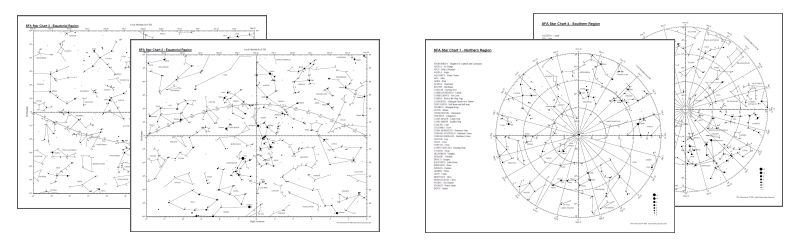
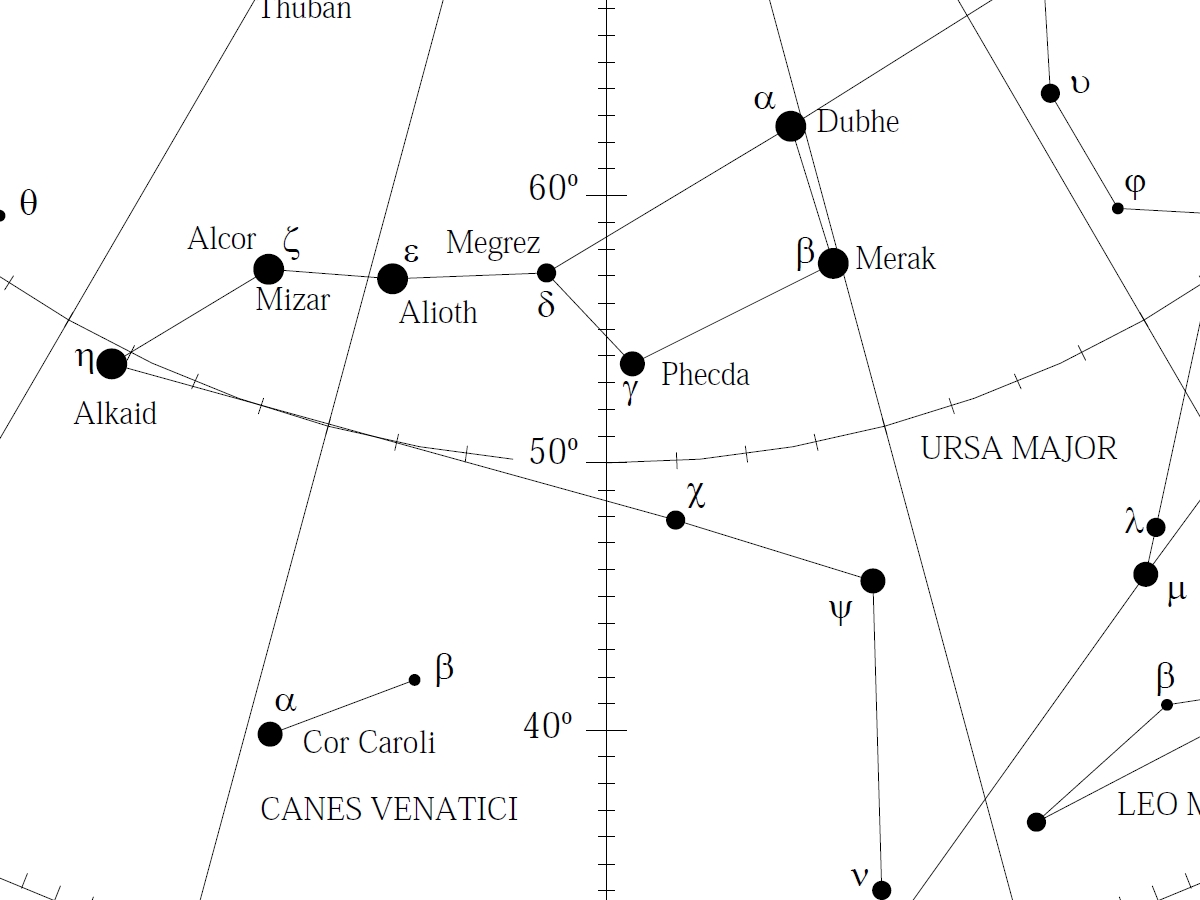
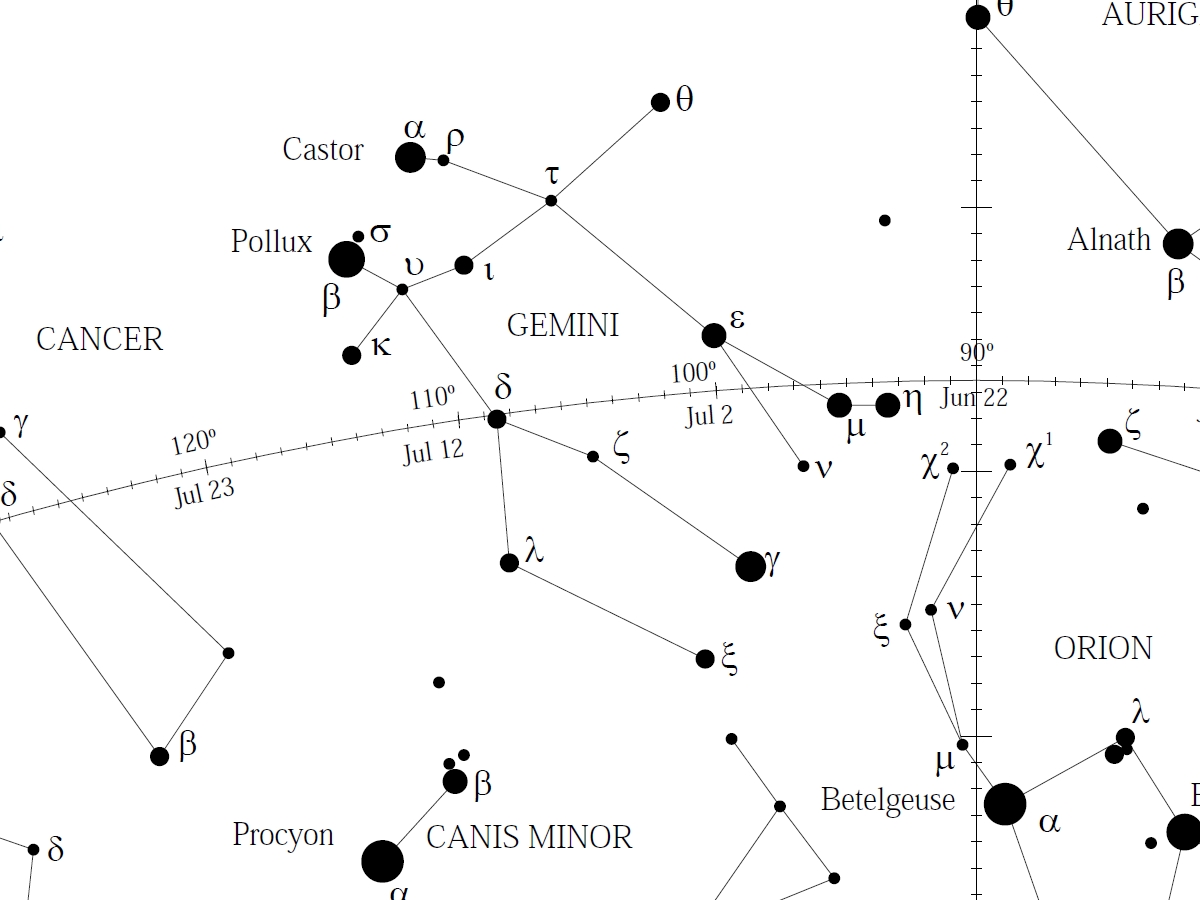
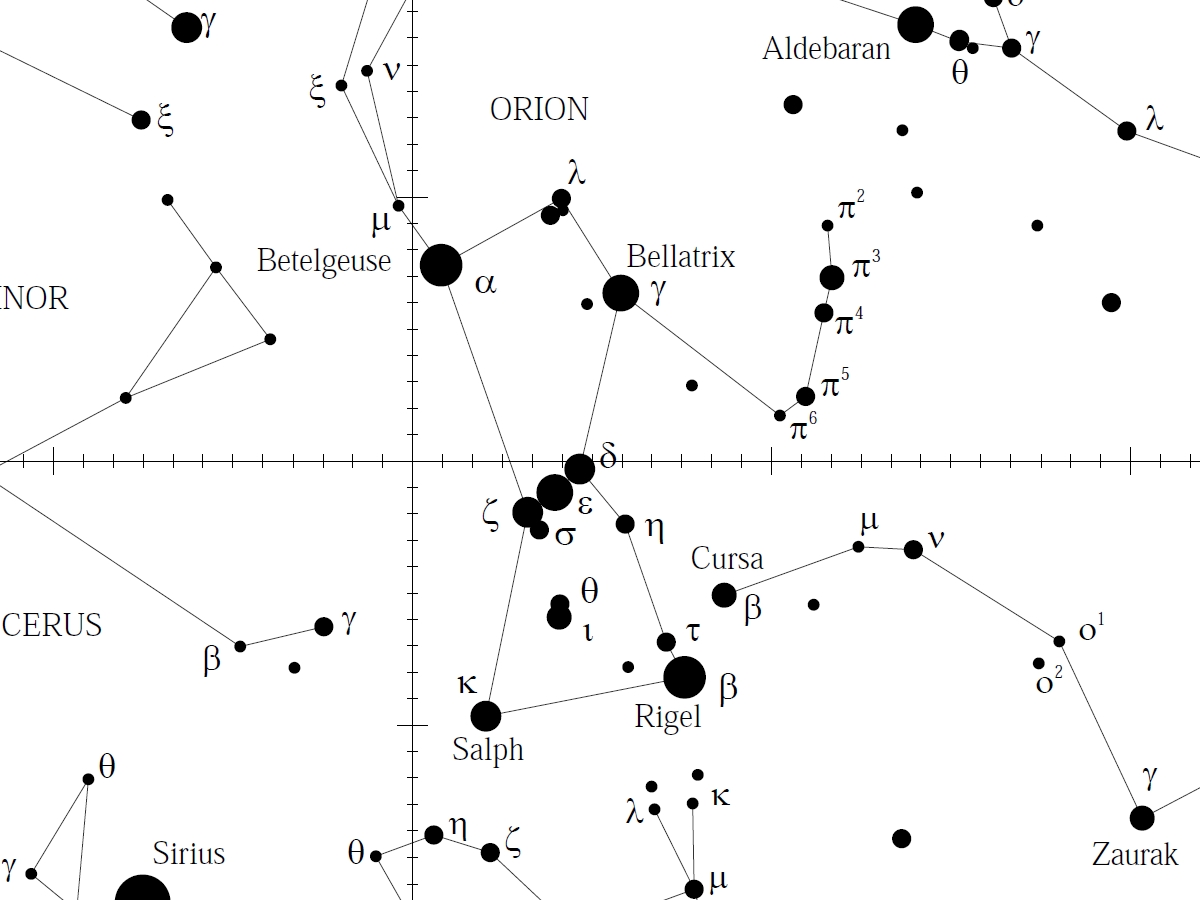
- Free SFA Star Charts
- Astronomy Orb
- Mars
- Jupiter
- Saturn
- SL9
- Eclipsing Binary Stars
- Color Science
- Astronomy JavaScript
- Movie Collection
- Stepper Motors